
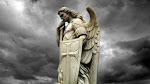
“Do not be afraid!” The message of the angel and our Lord to the women witnesses of the resurrection was simply this: “There is no need for you to be afraid” and “Do not be afraid!” This seems to be a strange message to these women unless it was meant to assure the women and the other disciples that the resurrected Lord was not a ghost, but fully alive in the flesh. I guess that’s what you would say if you came back to visit your family after you’re dead.
But these words could very well speak to all of us in our current situation - fear of failure, fear of aging, fear of separation, fear of losing control of our lives, fear of another economic recession or fear of the conflict in the Middle East and Europe ballooning into another World War. Or are we trapped in the trinity of fears which our neighbours in Singapore famously acknowledge - fear of losing, fear of death and fear of wives? But if we were to make a deep analysis of our fears, we would soon realise that they ultimately culminate in the fear of death, the fear of our final extinction. Our greatest fear is that when we die, we become nothing.
Let’s be honest, all of us fear dying. We seem to make a show of bravery by joking about it to our friends. But beneath the veneer of courage lies the fear of our inevitable mortality. One day all of us will die, sooner or later, for one reason or another. I am afraid of dying. I’m afraid of leaving behind a mess which others would have to clean up and perhaps suffer from their constant griping and complaining about my past mistakes. I’m afraid that I may be the last to go as I watch all my friends and family die before me, without anyone to mourn my passing. I fear the loss of heaven and the pains of hell, because I know I’m nowhere near as ready as I ought to be. Do we fear death? Should we? It’s comforting to know that Pope St John Paul II when asked during his transfer to the hospital for an operation to deal with colon cancer whether he was afraid, answered simply and clearly – and courageously, in my view: Yes!
Doctors will tell you that there are various ways of confirming before declaring that someone is dead. You look for the absence of certain vital signs. But the Catholic Church does not define it in a purely physical or physiological way. The Church’s definition is somewhat spiritual. Death is at the moment the soul is separated from the body. This is not something which can be determined empirically but rather can be explained theologically. Our soul, is created by God, comes to be at its union with the body. A body is simply dead without a soul, and a soul is “out of place” without a body.
I recalled accompanying my former Parish Priest, Fr Andre Volle, to pay respects and pray at the wake of his good friend and fellow French missionary, Fr Bernard Binet. As he filed pass the coffin of the corpse of his friend together with other well-wishers, he declared in a booming voice, a final funny jibe at his friend, “Oh Binet, this is not you!” Some would take the comment as inappropriate while others would assume that the ever-humorous Fr Volle was in form. But I understood that Fr Volle was theologically correct. Fr Binet’s body in the coffin was no longer Fr Binet. A body is simply dead without a soul, and a soul is “out of place” without a body.
That is why the resurrection is not merely the resuscitation of a body or a soul materialising for others to see but rather a person who truly died, his soul and body having separated, is made whole again - the body and soul are united again. This is truly amazing. It defies scientific and medical explanation. But it is crucial, it is central to our Christian belief! Why is the resurrection of the Lord such good news for us? Because the resurrection of Christ is a signal to us, an irrefutable proof to us that death is just a straw man, a toothless tiger. Though death may separate our souls from our bodies and may seem to sever our relationships with our loved ones, it does not have the final word. Christ has the final word.
Christ by His obedience conquered death and won resurrection and salvation for mankind. For those who live in Christ through Baptism, death is still painful and repugnant, but it is no longer a living reminder of sin but rather a precious opportunity to co-redeem with Christ, through mortification and dedication to others. St Paul assures us by declaring, “If we die with Christ, we shall also live with Him” (2 Tim 1:11). Hence, thanks to Christ, Christian death has a positive meaning. The enigma of death can only be understood in the light of Christ’s resurrection and our resurrection in Him.
Our Lord does not promise Christians complete success on this earth, for our earthly life is always marked by the Cross. He did not promise us an ageless and deathless existence, one free from pain, suffering and tribulations, for all must suffer and die. He promised us something far greater - eternal life, the life of the resurrection. The women who came to the tomb that first Easter morning were filled with grief and fear. But they left with something more – joy! Joy is not the absence of fear. Who says that one cannot be joyful even though we can be fearful of so many things, especially an uncertain future? Fr Paul Scalia, the son of the famous Catholic member of the US Supreme Court bench, Anthony Scalia, tells us that “only when that fear is present can joy arise. Easter joy is not something manufactured or created by us. It comes from the Resurrection or not at all, precisely and only when we surrender control and allow the risen Lord to intrude on our gatherings and activities just as surely as He appeared on the road, in the upper room, and on the seashore. If we want Him on our own terms – and thus without fear – then it is not the risen Lord we want, but a caricature,” a figment of our imagination.
So, my dear brothers and sisters, my dear catechumen, as some of you step forward to be baptised and others renew your baptismal promises, do so knowing that the Lord has conquered death and sin, the Lord has shown Himself victorious by rising from the dead, and the Lord will return one day in glory to call you forth from your graves, not just your souls but also with a new spiritually refined body. So, “do not be afraid!”


No comments:
Post a Comment
Terms of Use: As additional measure for security, please sign in before you leave your comments.
Please note that foul language will not be tolerated. Comments that include profanity, personal attacks, and antisocial behaviour such as "spamming" and "trolling" will be removed. Violators run the risk of being blocked permanently. You are fully responsible for the content you post. Please be responsible and stay on topic.