Thursday, June 10, 2010

Moving Forward with Grace and Forgiveness

Eleventh Ordinary Sunday Year C

What is the basis of our faith? What is at the heart of Christianity? Is it the obedience of God’s law and the laws of the Church? For many people, religion is seen merely in these terms – as the keepings of laws. A Catholic is one who must come to church every Sunday, must not eat meat on Friday, must go for confession at least once a year etc. When we begin to think of our religion as merely a set of laws, several things happen. When laws become the only consideration, our faith is then based on fear of judgment and punishment from God. If we obey these laws we will be blessed and nothing bad will happen to us, but if we break these laws then we will be punished and cursed.

When religion is based on fear, we become judgmental. We judge others by external appearances and behaviour. We are ready to catch people when they make a mistake and are quick to ostracise them from the community if they are habitual sinners. This was the kind of the mentality that the Pharisees had in today’s gospel. Based on his perception of his religion, the Pharisee who invited Jesus to his house only saw a sinful woman. This woman is described as one who had “a bad name in town.” Perhaps, this is an indication of the kind of lifestyle that she lived. She may have worked as a prostitute. For the Pharisee, this woman’s sin is too great and cannot be forgiven. She will always be remembered for the mistakes that she had made in the past rather than what she can become in the future.

How do we see others? Do we often judge others by appearance? Do we often remember their mistakes and use it against them?

Today’s readings remind us of what it really means to be a Christian. According to St. Paul in the second reading, “what makes a man righteous is not obedience to the law, but faith in Jesus Christ.” What does this mean? It means that religion is not just following a set of rules and laws. Religion and faith is based on relationship with God and Jesus Christ. So, what is at the heart of our faith must not be the laws but love. This is how God relates to us – not as a judge waiting to punish us when we have done wrong but as a God who loves us. St. Paul speaks of his faith: it is “faith in the Son of God who loved me and who sacrificed himself for my sake.”

Since our faith is based on love rather than the law, we are also called to mercy rather than judgment. Today’s gospel gives us the beautiful story of Jesus and the sinful woman. Jesus also tells a parable that highlights the importance of mercy and forgiveness. Jesus saw the woman differently. He knew that she was a sinner but he also knew of what she could become if given the opportunity. Mercy and forgiveness creates the opportunity for change. Mercy and forgiveness allows us to leave the past behind. Mercy and forgiveness is how God relates to us and he challenges us to also show mercy and forgiveness to others.

We have been speaking about our parish as a welcoming parish. In order for this parish to become a welcoming parish, we must first learn how to forgive. In order to welcome others, we must show mercy, not judgment. The sinful woman in today’s gospel showed hospitality to Jesus. In return, Jesus rewarded her with mercy and forgiveness. May we too begin to show mercy, understanding and forgiveness to one another. We recognize that we are all sinners. We acknowledge that we are not perfect. We admit that we have hurt one another by our selfishness and jealousies. But we should not be trap by these failings. The way forward is through forgiveness and mercy.

Tuesday, June 8, 2010

Reach Retreat 2010


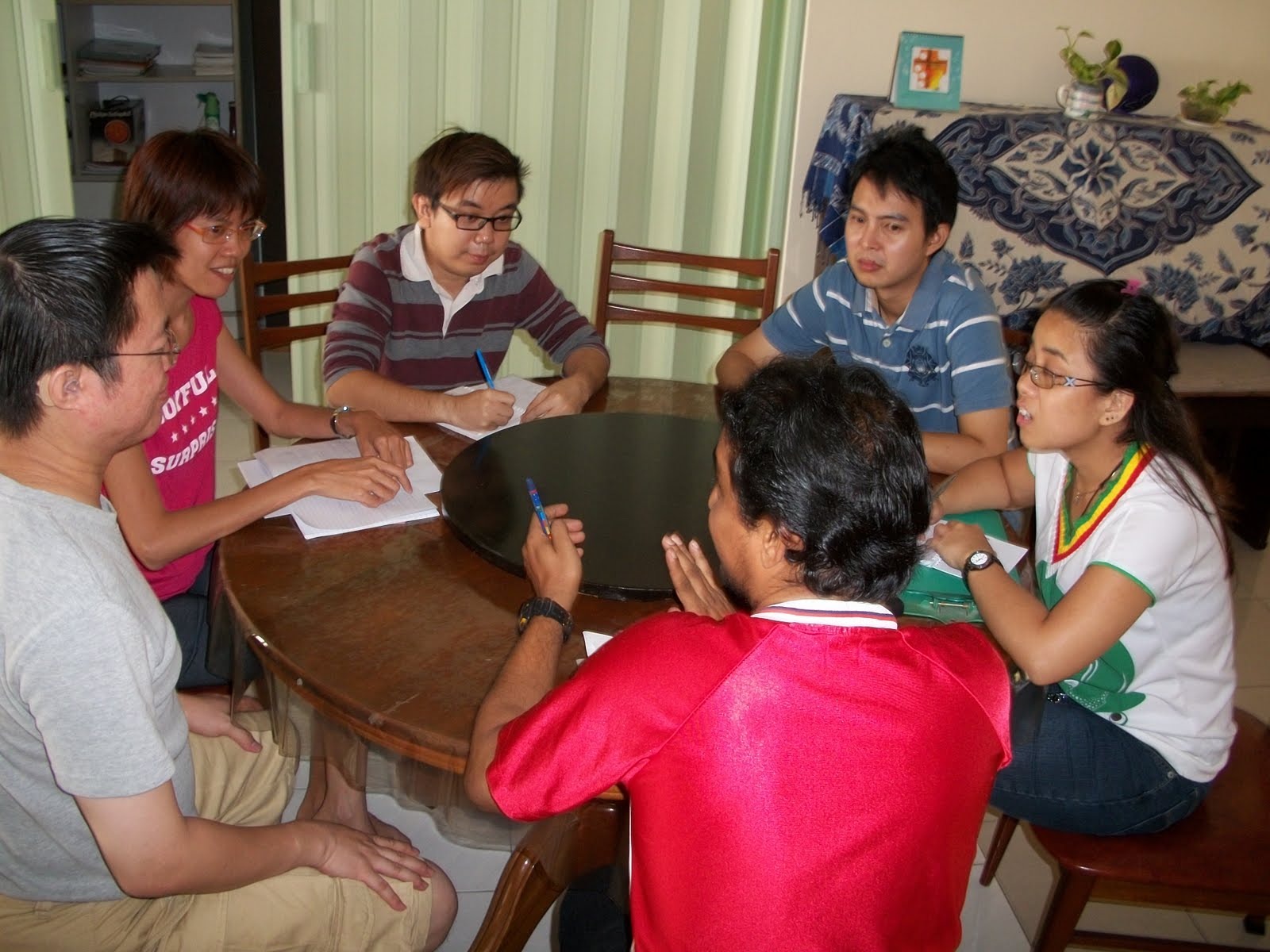
I spent the weekend (June 5-6) facilitating a retreat for the Reach Deaf Ministry of St Francis Xavier Church, PJ. Around 16 deaf persons and three hearing persons attended the retreat conducted at Villa Hermine, a convent cum retreat centre run by the FMM sisters.

The theme of the retreat was "Mary, the Model Disciple". Most of the deaf had little exposure to Marian devotion or theology. It was an opportunity to share with them the deep spirituality of Mary and how Mary could serve as their model of Christian discipleship.

The retreat took the form of a reflection of Icons and scriptural narratives which involved Mary, i.e. the Annunciation, the Visitation, the Wedding at Cana, the Crucifixion and Pentecost. In the last session, I shared with them the four Marian dogmas which arose from Christian imagination and Sacred Tradition.

More photos on Facebook.

Here's a video of me signing at the beginning of the mass:

Friday, June 4, 2010

A Meal for Strangers, A Meal that Unites, A Meal for Mission

Corpus Christi Year C

Much has been written and spoken about the Eucharist. Can anything else be said about it? I believe that the three readings of today can still give us some new insights.

In the first reading, we have Melchizedek, a foreigner, extending hospitality to Abraham. Melchizedek is not of the same race as Abraham, neither is he a close acquaintance. Melchizedek is in fact a stranger who goes out of his way and shows unusual hospitality to Abraham. Everytime we celebrate the Mass, Jesus extends hospitality to us. He does not only extend hospitality to those who are considered good and holy but also to strangers, luke-warm Christians, and sinners. The Eucharist is not an exclusive meal confined to only a few select people. We must always remember to extend hospitality to all who come to our Church, because in various ways they are hungering and seeking for meaning to their lives.

In the second reading, we read of St. Paul’s harsh words to the Corinthians. The main problem of the Corinthian church was the existence of factions. There were those who were rich and those who were very poor. There were those who thought themselves holier than others. There were those who were followers of Paul and others who were followers of Apollos. But in the Eucharistic community established by Jesus, there can be no room for factions. All are united in the Body of Christ. That is why St. Paul tells us that every time, we eat this bread and drink this cup, we are “proclaiming Christ’s death.” The Eucharist calls us to die to ourselves – to die to our selfishness, our prejudice, our suspicion of others.

Finally, the gospel tells us that the Eucharist calls us to be involved. There is no room for indifference and pushing the responsibility to others in the Eucharistic community. Jesus challenges us at every Mass – “give them something to eat yourselves.” The Mass does not depend on the priest alone. It depends on every one of you – in the way you participate in the Mass. You cannot complain of receiving nothing during the Mass if you do not take the trouble to contribute something. Each of you can contribute something by preparing yourself well before the Mass, by participating in the singing and the responses, and by listening attentively to the Word of God.

Every Mass is an occasion and an opportunity to extend hospitality to others- especially to strangers, the weak, the elderly, little children and those who seem to be alone. Every Mass is an occasion for us to die to ourselves and to our prejudices. Every Mass is an opportunity for us to participate in the mission of Jesus to establish God’s kingdom on earth. Let us pray during the Mass, for the grace to grow in our hospitality, in our self-denial and finally in our participation in the works of Christ.

Friday, May 28, 2010

God Reveals Himself in Love

Holy Trinity Sunday

Whenever some of us talk about the Holy Trinity, we often get a headache? Many of us are often caught up in the problem of numbers and mathematics – how can three be one and how can one be three? We often forget that this isn’t what the doctrine of the Holy Trinity is all about. Today’s readings give us three areas of reflection.

The doctrine of the Trinity highlights the fact that God is mystery. In the old testament, we read about God appearing on mountain tops and speaking from clouds. Mystery here doesn’t mean that God has kept many things secret. On the contrary, God has fully revealed himself in the person of Jesus Christ. When we speak of mystery, we are speaking of the limitations of human knowledge. Man may have advanced in science and medicine and many other fields, but he is still unable to explain everything. This is because man is himself a mystery. Life and death are mysteries. The universe is a mystery. Suffering is a mystery. Love is a mystery. And finally God is a mystery. Learning this truth will make us more humble. Learning this truth will make us understand that we do not have all the answers to all the problems in the world. Learning this truth will allow us to depend wholly on God and allow him to take charge of everything.

The second truth which we can learn from today’s feast is that God is a God of relationships. Mystery does not mean that God keeps at a distance. Although we can never fully know or understand the depth of God’s mind, we can still have an intimate relationship with him. In fact, man was created for relationship with God. This is possible only because God chooses to come close to us. He does not come close to us by descending from the clouds. God comes close to us by becoming one of us. God the Son came into the world in order to save it. God the Son became human, became one of us, so that we might become one with God.

God chooses to come close to us because he is love. This is the third truth that we can learn from today’s feast. If there is any quality which can best describe the nature of God, it is Love. The Trinity is not a thing. It is a relationship of persons. The Father loves the Son and the Son loves the Father and this love is perfected by the bond of the Holy Spirit. That is why St. Paul reminds us that we should “grow perfect; help one another, …be united, live in peace” because we are made in the image and likeness of this God of love and peace.

If we are to be signs of the Trinity in today’s world, then we must be people who are able to live with mystery. In other words, we must remind the world that there is more than meets the eye, that there is a greater truth than that which is revealed by science – it is God. We are also called to be witnesses of the Trinity through our way of life. We must strive to build communities where we can live in unity and peace and in mutual forgiveness. When we are able to express this in our actions and words, the Trinity ceases to be a mere concept but becomes alive in each of our lives.

Wednesday, May 19, 2010

Come Holy Spirit Come

Pentecost Sunday – Year C

Today, as we look around this congregation, we can imagine seeing the tongues of fire coming down on the heads of everyone here. After a period of waiting – 50 days of waiting – Jesus finally sends us the Advocate, the Holy Spirit, the one who will teach us everything and remind us of all that Jesus has said.

What is the significance of the coming of the Spirit?

First, the Spirit allows us to overcome our fears. Does this mean that we would no longer have any fears? No. We will always have fears. The opposite of fear is not courage but love – in fact, it is God’s love that overcomes our fears. It is love that help us to do things even when we are fearful of the consequences. Fear does not disappear, but it can no longer control us. In love, we allow the Spirit to take control of us. This was the experience of the apostles. Fearful, they hid behind closed doors. But when they were filled by the Spirit, they felt compel to go out from that room to proclaim the good news of Jesus Christ.

Secondly, the coming of the Spirit breaks down barriers between us and creates unity among people from diverse backgrounds. Today, the Church is not a Chinese Church, it is not an Indian Church, it is not a Malaysian Church. The Church does not belong to any particular group. The Church is the Church of Christ and all people, regardless of race, color or language are part of it. In the words St. Paul in the second reading, we are “children of God”, “heirs of God and coheirs with Christ.” If we were to live according to the Spirit, then we must not allow prejudice to affect the way we live our Christian lives. If language had been a barrier to the early Christians, as in the case of the first reading, the Holy Spirit breaks down even that barrier. Different peoples can still be united in Spirit even if they do not share a common language. What does this tell us about our own parish situation? Each of us must seriously reflect over this.

This is the reason why the Church is different from every other social group. Social groups consists of members who share a common interest, or a common language or a common project. This can never be the case for the Church. The Church is made up of peoples from diverse backgrounds. We must be able to look after the interest of everyone and not only look towards our own interest. The Church is not Barisan Nasional, made up of different racial parties – UMNO, MCA or MIC.

Thirdly, the Spirit comes to “teach you everything and remind you of all (Jesus) has said to you.” We need to be reminded because we forget so easily especially when we encounter problems. We need to be reminded constantly of our identity as children of God. We need to be reminded constantly that we are brothers and sisters in Christ. We need to be reminded that our new life in the Spirit is a life that must be founded on love. Life in the Spirit means that there is no room for hatred, prejudice, unforgiveness, or selfishness.

We give thanks to God for the gift of the Holy Spirit. He is truly our Advocate, our helper. Let us make room for him in our hearts that we will always be ready to listen to his prompting.

Come, Holy Spirit, come!

Friday, May 14, 2010

"We" vs "They"

Seventh Sunday of Easter Year C


“We…” “They …” We often use these words to refer to different groups of people. “We” usually refers to the group which I personally can identify with. I’m a member of this group. This group of mine shares common interest and are like-minded. This group of people are my friends and my loved ones.

“They” is often used to refer to people who do not belong to that special group of ours. These people are outside my group of friends and loved ones. These people are considered different – whether it be a different opinion, a different language, a background or a different religion. Very often the “we” are against “them.” They are not our friends. We distrust them. We don’t like them.

Very often, we tend to think like this. We tend to make distinctions. We tend to see our differences rather than to recognize what is common between us. “Why are we helping the Mandarin or Tamil speaking?” “Why are we taking care of the needs of the migrants?” “We should only take care of our own.”

Today, Jesus reminds us that on this world there are no ‘we’ and ‘they.’ All of us are God’s children. All of us are recipients of the saving grace of Jesus. All of us are called to be that One family of God. There is no room for division and distinction in this one family of God. The poor will not be separated from the rich. The educated will not be separated from the uneducated. People of different languages and different cultures will not be separated and placed in different rooms.

This is the prayer of Jesus during the last supper just before his death. He was concerned not only for his disciples, those that the Heavenly Father had given into his care, but also for the others – the unconverted, those who rejected him and would put him to death, his greatest enemies. And so Jesus prayed: “Holy Father, I pray not only for these, but for those also who through their words will believe in me. May they all be one. Father, may they be one in us as you are in me and I am in you.”

This is the reason why we cannot only be praying for our loved ones and friends. We cannot only be helping people who are close to us. We are also called to pray for the “others” – for our enemies, for people who hurt us, for those speak ill of us, for those who think differently, for those who are of a different skin colour or language. Filled with the Holy Spirit, Stephen did exactly this. As he was being stoned by his enemies, he prayed that God would forgive them their sins.

One day, we will all walk hand in hand into the gates of heaven. We will hear the voice of Jesus inviting us to enter into the new Jerusalem. If we are unable to face our enemies and people whom we dislike now, how can we possibly live with them for eternity after death. In heaven, there can be no division, hatred or unforgiveness. There is only unity and love. While we are still alive in this world, let us begin to work for unity and reconciliation because heaven is only a perfect reflection of the way we have lived here on earth. May our robes be washed clean by the time we stand before Jesus, the Alpha and the Omega, the First and the Last, the Beginning and the End. May we be one as Jesus, the Father and the Holy Spirit are one.

Thursday, May 6, 2010

The Advocate and the Church

Sixth Sunday of Easter – Year C


Making decisions can be very difficult especially when everyone seems to have their own opinion. You and I know that each of us always think that our own opinion is always the most important of all. That is the reason why we have disagreements which may even lead to conflict and later to disunity.

That was also the problem of the early Christians. Some of the early Christians believed that they should still follow the Jewish customs, for example circumcision and prohibitions towards certain foods. For them, Jesus was a Jew and had also followed Jewish ways and rituals. But there was also another group of Christians who were able to recognize the newness brought about by Jesus. Jesus was not merely another Jewish teacher who wanted to reform his religion, but he was the Son of God who came to announce the good news of the kingdom of God. And within this kingdom, customs and rituals which separated one race from the other could no longer be barriers to Christian brotherhood.

And so a problem was presented to the Council of Jerusalem, the assembly of Christian leaders, who came together to decide on this critical matter – whether non-Jewish (Gentiles) converts to Christianity should adopt the practices of the Jews. After long discussion a decision was made – the Gentile converts should “not be saddled with any burden beyond certain essentials.”

Throughout the centuries, the Church has also experienced many crisis that threatened to break its very foundation and unity. In the early centuries, many Church leaders were divided as to whether Jesus was God; and if he was God, was he equal to God the Father. In later centuries, there were also disagreement about many church teachings and practices. In the 15th and 16th century, the Church also faced the crisis of the Reformation where many Protestants broke away from the Catholic Church. In the last century, faced with the rapid development of society and new problems emerging there from, the Church’s bishops came together in Rome to decide on the future of the Church – and so we had the famous Second Vatican Council which has affected the lives of everyone.

Throughout all these centuries, throughout all these years of crisis and trials, the Church has continued to survive and grow, only because of the guidance of the Holy Spirit. The Holy Spirit is the gift of the Father and the gift of Jesus to the Church and to each of us who are believers. He is sent to as to “teach you everything and remind you of all (Jesus) have said to you.” His presence guarantees that we will experience peace in our decisions even in the midst of chaos and problems. His guidance ensures that in spite of all our personal opinions and ways of thinking, we can still come to a common decision that reflects the will of God. In other words, he is the guarantee of unity within the Church. Without the Holy Spirit, the Church and unity would not be possible.

We must therefore always remember that our decisions must always be made with reference to the Church and the community as a whole. It is that same Spirit which will inspire each of us. There is always the temptation to think that my opinion is the best and the most important of all. But what matters most is not this or that opinion or even the opinion of the majority, but it is the will of God that we must always search for with the guidance of the Holy Spirit. Let us continue to treasure the gift of the Holy Spirit and give thanks to God because the Holy Spirit is the sure hope and promise that God has not and will never abandon us.